
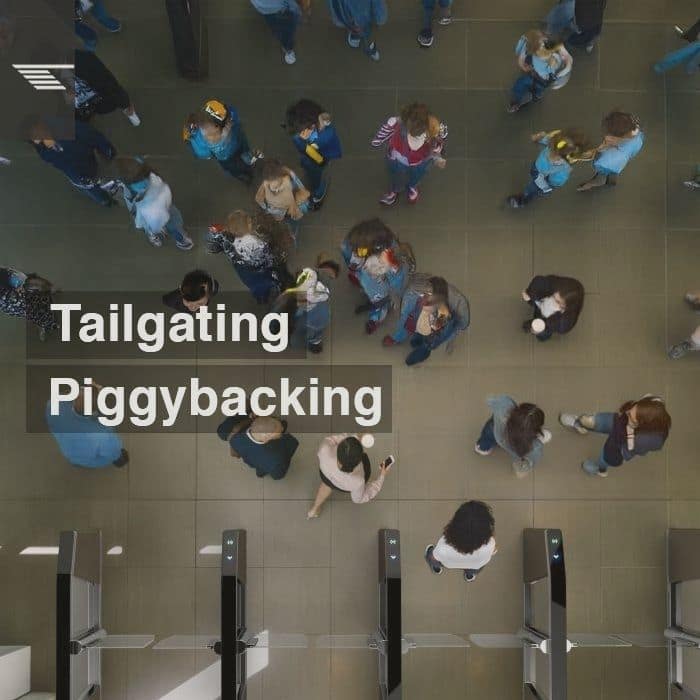
A secured door only works when every person passing through it has been verified. That is the core issue behind tailgating vs piggybacking. In both situations, someone enters a controlled business area without completing the required access process.
Tailgating usually happens when an unauthorized person follows an approved user through a secured entrance without that user intentionally granting access. Piggybacking generally involves an authorized person knowingly letting another individual enter with them.
The distinction matters because each behavior takes advantage of a different weakness. Tailgating commonly relies on door timing, crowded entrances, or poor traffic control. Piggybacking is more likely to exploit courtesy, trust, pressure, or social engineering.
For businesses, the priority is ensuring one approved credential does not automatically grant entry to two people.
What Is Tailgating in Physical Security?
Tailgating is unauthorized entry gained by closely following someone who has legitimate access to a protected area.
For example, an employee presents a badge at a controlled office entrance. The reader accepts the credential and unlocks the door. Before it closes, another person slips through without presenting a badge.
Tailgating can occur at employee entrances, office suites, warehouses, loading areas, parking access points, server rooms, storage areas, and other restricted spaces.
What Is Piggybacking in Physical Security?
Piggybacking generally occurs when an authorized person knowingly allows someone else to enter a secured area without completing the normal verification process.
The request may sound harmless:
- “I forgot my badge.”
- “I have a delivery.”
- “My card isn’t working.”
- “I’m here to repair the network.”
Instead of directing that person to reception or another verification point, the employee holds the door open.
That is why a piggybacking attack is closely connected with social engineering.

Tailgating vs Piggybacking: What Is the Difference?
The main difference in tailgating vs piggybacking is usually how much the authorized person participates in the unauthorized entry.
| Security Issue | Tailgating | Piggybacking |
| How entry happens | Someone follows an authorized user through a controlled entrance. | An authorized user lets another person enter. |
| Employee involvement | Usually unaware of the unauthorized entry. | Knows the second person is entering. |
| Typical example | Someone slips through before the door closes. | An employee holds the secured door open. |
| Weakness exploited | Traffic flow, timing or doorway control. | Trust, courtesy or social engineering. |
| Main prevention focus | Entry controls, monitoring and detection. | Verification, access policy and training. |
How Do Tailgating and Piggybacking Happen at Businesses?
These incidents frequently take advantage of everyday workplace habits rather than sophisticated attack techniques.
- Busy Entrances
Morning arrivals, lunch periods, meetings, and shift changes can place many people at one access point. An unfamiliar individual may move through with the group before anyone notices.
- Employees Holding Doors
Holding a door is normally polite. At an access-controlled entrance, however, it can bypass the process the business installed to verify each user.
- Employee or Contractor Impersonation
Someone may claim to be an employee who forgot a badge, a technician completing a repair, or a delivery worker who needs to get inside.
Tools, packages, work clothing, or a confident explanation can make the story look legitimate.
- Shared Credentials
When several people use the same card, fob, or PIN, the access record becomes less useful because the business cannot reliably determine who actually entered.
- Propped Doors
A reader cannot control access through a doorway intentionally left open during deliveries, maintenance, cleaning, or employee breaks.
- Old Access Permissions
Former employees, temporary workers, or contractors may retain access after they no longer have a business reason to enter. Permissions should change when employment, assignments, or vendor relationships change.
How Can Businesses Prevent Tailgating and Piggybacking?
Strong tailgating prevention combines technology, access policies, entrance design, and employee behavior.
1. Require Individual Access Credentials
Every person entering a controlled area should use their own approved credential.
Cards, fobs, PINs, mobile credentials, and other identifiers should not be shared.
A clear one-person, one-credential, one-entry policy improves accountability and makes access records more useful when an incident needs to be reviewed.
2. Limit Access by User, Area, and Schedule
Not every employee needs permission to enter every room.
Commercial access control can restrict entry according to:
- User
- Department
- Door
- Floor
- Work schedule
- Restricted area
- Temporary access period
An employee may need the main office entrance but have no business reason to enter the server room, inventory cage, or records area.
Limiting permissions reduces unnecessary access inside the property.
3. Establish Visitor and Contractor Procedures
Employees should not have to decide at a secured doorway if an unfamiliar person belongs inside.
Visitors, delivery personnel, contractors, and vendors should follow a defined process for check-in and verification.
Temporary credentials can also be limited by time and location. A contractor working on one floor for one day should not receive unrestricted building access.
4. Integrate Access Control With Video Surveillance
Access records and video answer different questions.
Access control tells you which credential was accepted. Video surveillance helps show what happened around the entrance.
When both systems work together, security teams can determine if:
- One person entered
- Multiple people crossed the doorway
- Someone waited near the entrance
- Suspicious activity occurred around an access event
Video coverage is particularly useful at employee entrances, loading areas, restricted interior doors, storage areas, and after-hours access points.
5. Add Stronger Entry Controls Where Needed
Some locations require tighter traffic control than a standard secured door.
Businesses may consider:
- Turnstiles
- Controlled access vestibules
- Mantrap-style entry
- One-person-at-a-time entrance controls
- Other anti-tailgating systems
These measures can be useful around data rooms, financial operations, high-value storage, critical equipment, or other sensitive areas.
That does not mean every doorway requires the same controls. Security should match the actual risk of the location.
6. Strengthen Authentication for Sensitive Areas
A card or fob may provide enough authentication at a normal employee entrance, while a higher-risk room may require an additional factor.
Depending on the facility, businesses may use:
- PINs
- Mobile credentials
- Biometric authentication
- Credential combinations
The purpose is not to make every entrance difficult to use. Stronger authentication should be applied where unauthorized access would have a greater impact.
7. Monitor Important Door Events
An access-control system can provide useful information beyond simply locking and unlocking doors.
Businesses can monitor events such as:
- Door forced open
- Door held open too long
- Repeated denied access
- After-hours entry
- Unexpected activity at restricted doors
Connecting these events with surveillance, intrusion detection, or professional monitoring can provide additional context when something requires attention.
8. Revoke Credentials Promptly
Physical access should be part of employee and contractor offboarding.
Remove or update permissions when:
- An employee leaves
- An employee changes roles
- A contractor finishes a project
- A temporary assignment ends
- A badge is lost
- A vendor no longer requires access
Temporary credentials should expire automatically when possible instead of remaining active indefinitely.
9. Train Employees on Secure Entry
Technology cannot fix piggybacking if employees routinely bypass the access procedure.
Staff should know exactly what to do when someone says:
“I forgot my badge.”
“I’m making a delivery.”
“I’m here for maintenance.”
Instead of making the decision themselves, employees should direct the person to reception, security, a facility manager, or another approved verification point.
The rule is clear:
Courtesy should not replace authorization.
Employees can remain helpful without opening a secured area to an unverified person.

Can Security Cameras Alone Prevent Tailgating?
No. Security cameras alone cannot prevent tailgating.
Cameras provide visibility and evidence. They can help show how many people crossed an entrance, support investigations, and give security personnel more information when suspicious activity occurs.
However, a camera does not determine who has permission to enter, nor does it physically restrict passage through an open door.
Different security layers perform different jobs:
- Access control determines authorization.
- Credentials identify approved users.
- Video surveillance provides visual context.
- Physical entrance controls regulate passage.
- Intrusion detection identifies defined security events.
- Monitoring supports response.
- Employee procedures reduce human error.
The strongest approach connects these functions instead of expecting one technology to handle every problem.
Can Access Control Completely Stop Tailgating?
Access control is central to preventing unauthorized entry, but a standard card reader alone cannot guarantee that only one person passes through after a door unlocks.
A successful credential tells the system:
This user has permission to open this door.
It does not necessarily tell the system:
Only this user entered.
Higher-risk entrances may therefore require additional door monitoring, video verification, controlled vestibules, turnstiles, visitor controls, or other anti-tailgating measures.
Which Businesses Need Stronger Anti-Tailgating Security?
Any organization with restricted areas can face tailgating, but some properties require tighter controls because of their traffic, assets, or sensitive spaces.
These may include:
- Corporate offices with busy employee entrances.
- Warehouses with employees, drivers, vendors, and temporary workers.
- Data centers protecting servers and critical infrastructure.
- Healthcare facilities with staff-only and records areas.
- Manufacturing facilities with production and equipment zones.
- Financial organizations protecting sensitive operations.
- Multi-tenant properties separating public and tenant areas.
- Facilities receiving frequent contractors or deliveries.
Security requirements should be based on building design, visitor activity, operating hours, traffic flow, and the impact unauthorized entry could have on each area.
How Titan Alarm & Fire Helps Businesses Control Unauthorized Entry
Tailgating prevention works better when security systems are designed around how people actually enter and move through a property.
Titan Alarm & Fire can help businesses combine commercial access control, access credentials, visitor and vendor permissions, video surveillance, intrusion detection, audit records, monitoring, and higher-security entrance controls where they are appropriate.
The value comes from connecting those layers.
An access event can identify which credential opened a door. Video can provide visual context around that event. Door monitoring can identify abnormal conditions. Intrusion systems and monitoring can support a faster response when activity requires attention.
This approach gives businesses more useful information than relying on an isolated badge reader, camera, or alarm.
If your facility has busy employee entrances, restricted rooms, regular contractor traffic, shared commercial spaces, or other unauthorized-access concerns, contact Titan Alarm & Fire to assess your entry points and determine which security controls fit the risk at each location.
Final Thoughts
The distinction between tailgating and piggybacking mainly comes down to how the unauthorized person gets through the entrance. Tailgating generally involves following someone inside without separate verification, while piggybacking usually involves an authorized person allowing the other individual through.
Both expose the same security weakness: one legitimate access event can become entry for someone who was never verified.
Businesses can reduce that risk by combining individual credentials, controlled permissions, visitor procedures, video surveillance, stronger entrance controls, door monitoring, fast credential removal, and employee training.
A secured entrance is strongest when people, access policies, physical controls, surveillance, and response procedures work together.
FAQs
Is tailgating a physical security breach?
Yes. The person reaches a controlled area without completing the required authorization process, even if the door was originally opened using a valid employee credential.
Is piggybacking a social engineering attack?
It can be. Someone may pose as an employee, technician, delivery worker, or contractor to convince an authorized person to let them through a secured entrance.
Can access control prevent tailgating?
Access control helps reduce tailgating by requiring individual credentials and limiting permissions. However, a standard reader may not stop another person from following an authorized user through the door after it opens.
Can security cameras detect tailgating?
Security cameras can help verify suspicious entry activity and show how many people crossed a doorway. They provide stronger value when video can be reviewed alongside access-control events.
What is an anti-tailgating system?
An anti-tailgating system uses physical or electronic measures to reduce or detect multiple people entering under one authorization. Examples include controlled vestibules, turnstiles, mantrap-style entrances, door monitoring, and video-based detection.
Which entrances should businesses assess first?
Start with busy employee entrances, loading areas, restricted interior doors, and access points protecting sensitive information, valuable inventory, equipment, technology systems, or other critical business areas.