
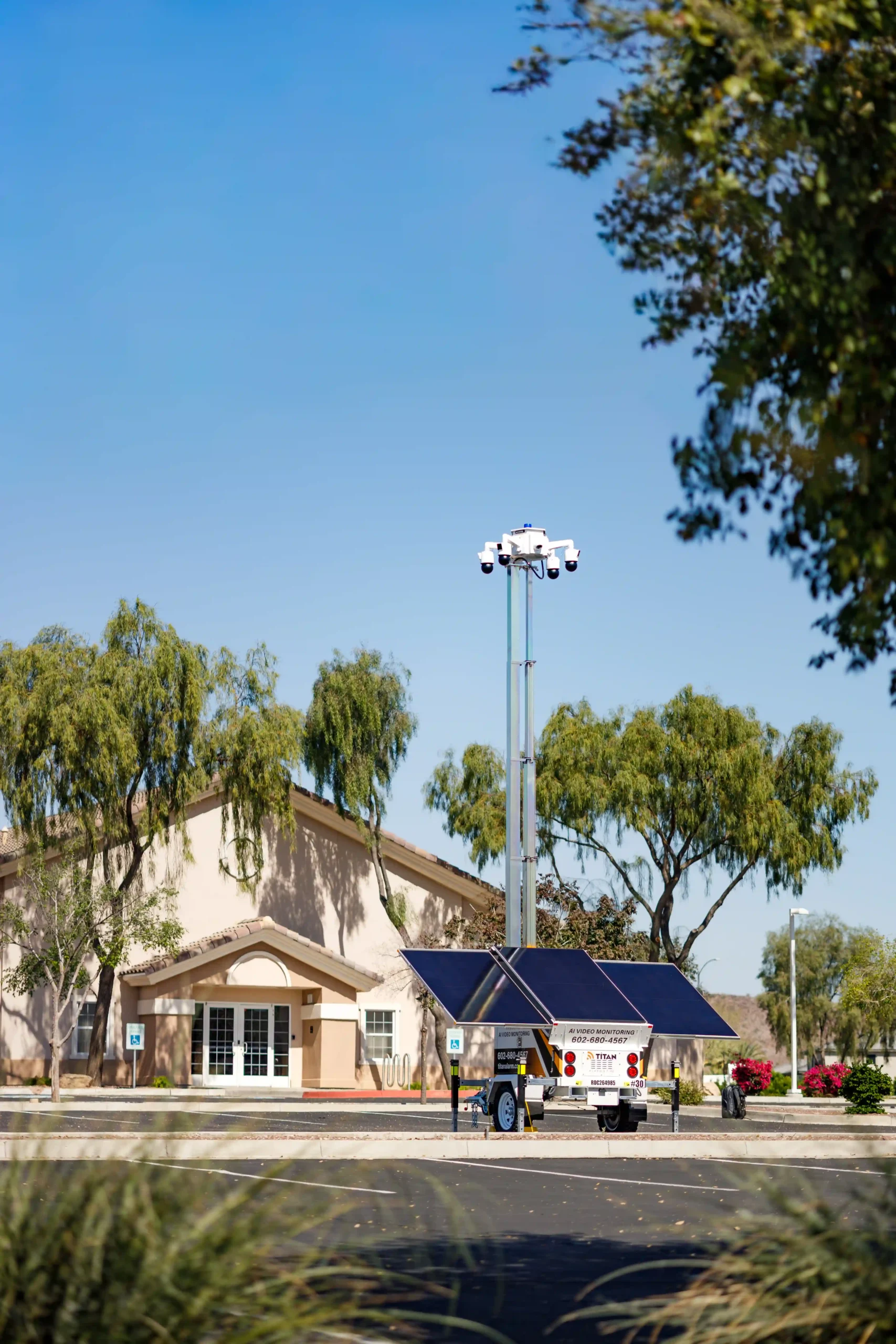
A construction site, equipment yard, parking lot, or vacant property may need security cameras before permanent electricity or wired internet is available. A solar surveillance trailer provides another way to secure these locations without first installing permanent infrastructure.
A solar surveillance trailer is a towable video security system that combines solar panels, battery storage, elevated cameras, cellular connectivity, recording equipment, and remote access. Depending on the configuration, it may also include video analytics, professional monitoring, talk-down audio, sirens, strobe lights, and response support.
Its main advantage is mobility. Instead of designing the property around fixed cameras, businesses can move surveillance coverage as access points, equipment, materials, and security priorities change.
What Is a Solar Surveillance Trailer?
A solar surveillance trailer is a mobile security system that uses solar panels and battery storage to operate security cameras and communication equipment without relying on permanent site power.
Most systems place cameras on an elevated mast and transmit video through a cellular network. This allows authorized users or monitoring personnel to view activity remotely even when the property has no wired internet connection.
A typical unit may include:
- Solar panels
- Battery storage
- Fixed, panoramic, or PTZ cameras
- Infrared night vision
- Telescoping camera mast
- Cellular connectivity
- Video recording
- Remote viewing software
- Video analytics
- Talk-down loudspeakers
- Sirens or strobe lights
You may also see these systems called mobile surveillance trailers, solar security trailers, solar CCTV trailers, or portable surveillance units.
The terminology varies, but the basic purpose is the same: bring power, cameras, communications, and security monitoring to the location that needs coverage.

How Does a Solar Surveillance Trailer Work?
A mobile surveillance trailer follows a simple operational chain:
Solar generation → battery storage → video capture → detection → cellular transmission → verification → deterrence or response
Understanding those stages helps businesses compare systems based on more than camera count.
- Solar Panels Generate and Store Power
Solar panels produce electricity during daylight hours. That energy powers the equipment and charges the trailer’s battery system.
The batteries then keep the cameras, communications hardware, and other equipment operating after sunset or when solar generation drops.
This means the trailer does not need direct sunlight every moment it is operating.
However, solar performance still depends on system design. Camera load, battery capacity, panel placement, shade, connected equipment, and environmental conditions all affect how much operating reserve is available.
Businesses should therefore ask how the trailer’s power system was sized for their actual configuration instead of judging it only by the size or number of panels.
- Elevated Cameras Monitor Priority Areas
Security cameras are installed on a raised mast to provide a wider view across open properties.
Different sites need different views.
A vehicle gate may need focused coverage of traffic entering and leaving. An equipment yard may require wider observation across several storage rows. A construction project may need cameras aimed at valuable materials during one phase and another section of the property later.
Depending on the system, the trailer may use fixed cameras, panoramic views, PTZ cameras, infrared technology, or a combination.
- Cellular Connectivity Sends Video Off-Site
Mobile trailers commonly use cellular connectivity rather than relying on the property’s Wi-Fi or wired network.
This is a major advantage for construction projects, vacant land, remote equipment yards, and undeveloped commercial sites.
Authorized users can access live or recorded video remotely, while monitored systems can send security events to off-site personnel.
Cellular service still needs to be considered before deployment. A trailer should not be placed solely for the best camera view if the location creates poor communication performance.
- Monitoring Adds Verification and Response
A camera recording something and a monitored security response are not the same thing.
There are several separate stages:
- Recording: The system captures video for live viewing or later review.
- Detection: Motion or configured analytics identify activity that may require attention.
- Verification: An operator or authorized user checks the video to determine what is actually happening.
- Deterrence: Speakers, sirens, or strobes can warn an unauthorized person that the site is being monitored.
- Response: Confirmed threats can be handled according to the property’s response plan.
This process is one of the most important differences between a passive camera and a professionally monitored solar security trailer.
What Features Matter Most in a Solar Surveillance Trailer?
The strongest system is not necessarily the trailer with the longest equipment list.
The features should match the property.
- Useful Camera Coverage
Camera resolution matters, but placement and viewing angle matter just as much.
Businesses should know which gates, storage areas, equipment zones, vehicle rows, fence lines, or other locations each camera will actually cover.
- Night Visibility
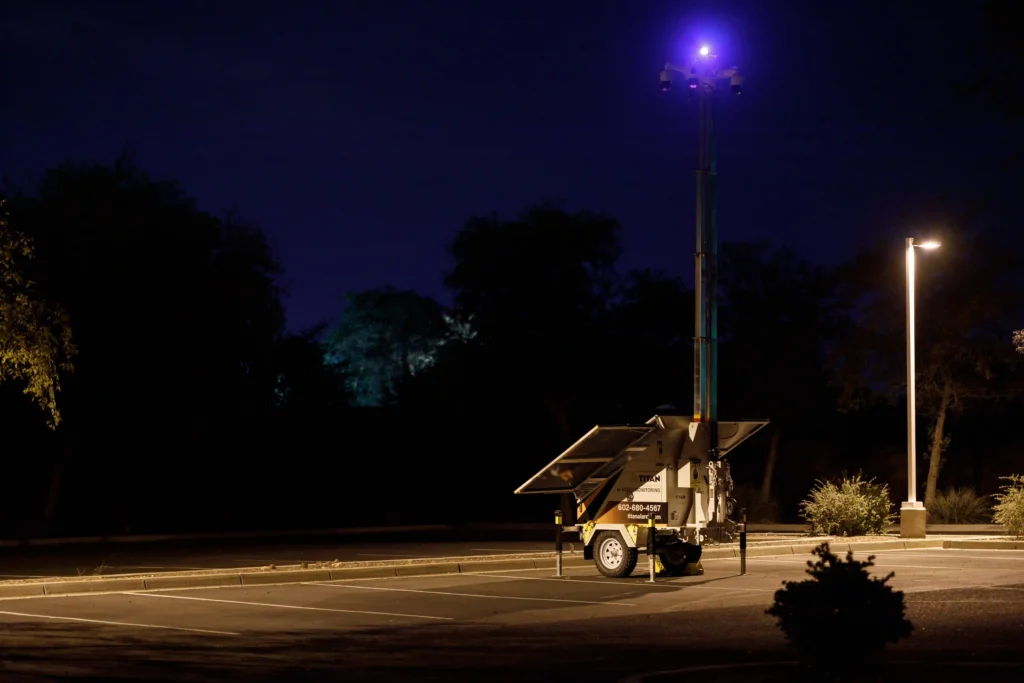
Outdoor sites still need useful surveillance after crews leave.
Infrared or other low-light camera capabilities help provide video when normal lighting is limited.
- Battery Reserve
Ask how long the configured equipment can operate when solar generation is reduced. The answer should consider the actual cameras, communications equipment, monitoring hardware, and deterrence devices installed on the trailer.
- Remote Access
Site managers may need to check gates, vehicles, equipment, deliveries, or suspicious activity without driving to the property.
Remote access makes the trailer useful for operations as well as security review.
- Video Analytics
Analytics can help identify configured events, such as movement within a selected area or activity around a restricted zone.
Analytics assist detection. They should not be treated as a replacement for verification or an appropriate response process.
- Active Deterrence
Talk-down audio, sirens, and strobe lights can help address suspicious activity while it is occurring instead of simply creating footage for review the next day.
- Trailer Protection
The surveillance unit itself should also be protected against tampering or theft.
Ask what cameras, alarms, locks, or other controls protect the trailer.
Solar Surveillance Trailer vs. Fixed Security Cameras
Both technologies have valid uses.
| Factor | Solar Surveillance Trailer | Fixed CCTV |
| Power | Solar + battery | Usually permanent electrical service |
| Connectivity | Commonly cellular | Usually property network |
| Installation | Minimal permanent site work | May require cabling and mounting |
| Mobility | Can be repositioned | Remains fixed |
| Temporary sites | Strong fit | May require unnecessary installation |
| Changing layouts | Coverage can move | Additional installation may be needed |
| Permanent facilities | Useful in selected situations | Usually better for long-term coverage |

A permanent office, warehouse, or commercial building with established utilities may be better served by a fixed commercial video surveillance system.
A construction site with temporary roads, moving equipment, new buildings, and changing storage zones has a different problem.
The right choice depends on how stable the property and its security priorities are.
Solar Surveillance Trailer vs. Security Guard
A mobile surveillance trailer and a security guard perform different jobs.
| A monitored trailer can: Watch multiple camera views. Record security events. Detect configured activity. Support remote verification. Issue audio warnings. Activate sirens or strobes. Preserve video evidence. | A security guard can: Physically patrol. Check credentials. Interact with employees and visitors. Inspect gates or fencing. Investigate conditions in person. Maintain an on-site human presence. |
One does not automatically replace the other. A property that mainly needs after-hours detection, video evidence, and remote intervention may benefit from monitored mobile surveillance. A property requiring physical patrols or visitor control may still need security personnel.
Some sites may use both.
Where Are Solar Surveillance Trailers Used?
Mobile trailers are especially useful where the property is temporary, outdoor, geographically large, or still waiting for permanent infrastructure.
- Construction Sites
Construction projects change constantly.
Materials move between phases. Temporary fencing changes. Access gates are relocated. Equipment may be stored in different sections as work progresses.
A camera location that worked during site preparation may provide little value later.
A mobile surveillance trailer can follow those changes without requiring a new permanent camera installation every time the security priority moves.
- Equipment and Storage Yards
Large outdoor yards can contain vehicles, machinery, tools, materials, and inventory spread across significant areas.
A trailer can focus cameras on entrances, equipment rows, loading zones, or other high-value sections.
- Auto Dealerships and Parking Lots
Large outdoor vehicle areas may need additional coverage around entrances, vehicle rows, service areas, or locations experiencing after-hours activity.
A trailer can also provide temporary coverage during construction or changes to an existing parking area.
- Vacant Properties
Vacant land and unoccupied buildings may lack operating utilities but can still face trespassing, vandalism, dumping, or unauthorized entry.
A solar-powered system allows cameras to be installed without first restoring site infrastructure.
- Solar Farms and Remote Projects
Remote construction and infrastructure projects are often located far from buildings, fixed networks, or existing camera mounts.
Solar power and cellular communication make mobile surveillance useful in these conditions.
- Data Center and Multifamily Construction
Large projects may contain valuable materials and equipment before their permanent security systems are ready.
Mobile surveillance can bridge that period while the property continues to change.
What Should You Ask Before Choosing a Solar Surveillance Trailer?
Before selecting a provider, ask:
- What areas will each camera cover?
- How will the site be monitored after dark?
- How was battery reserve calculated?
- Has cellular connectivity been tested?
- Can managers view live and recorded footage remotely?
- How long is footage retained?
- What events trigger monitoring?
- Who verifies an alert?
- What happens after a threat is confirmed?
- Is live talk-down audio available?
- Can sirens or strobes be activated?
- How is the trailer protected against tampering?
- Can the unit be moved as the site changes?
- Who handles delivery, setup, maintenance, and retrieval?
These questions reveal more about the real service than mast height or camera count alone.

How Titan Alarm & Fire Provides Solar Surveillance Across Arizona
Titan Alarm & Fire provides solar surveillance trailers in Arizona for construction sites, equipment yards, auto dealerships, solar farm projects, data center construction, multifamily developments, parking lots, vacant properties, and other outdoor commercial sites.
Our system combines solar-powered operation with cellular connectivity, motion recording, remote camera access, live monitoring, talk-down loudspeakers, sirens, strobe lights, AI video monitoring support, recorded footage, and trailer self-protection cameras.
For confirmed security threats, Titan can also support escalation to local law enforcement.
The practical value comes from connecting the complete security workflow:
Detection → verification → deterrence → response
Site managers can remotely check gates, vehicles, equipment, materials, deliveries, and other activity without waiting until the next morning to see what happened.
Because the trailer is mobile, coverage can also be repositioned as access points, stored materials, equipment, and project phases change.
For Arizona properties without permanent utilities, or sites where the risk area will move over time, that combination can provide a more practical approach than installing temporary fixed infrastructure.
Final Thoughts
A solar surveillance trailer is most useful when traditional camera infrastructure does not fit the property.
Solar generation removes the need for permanent site power. Cellular connectivity supports remote access. Elevated cameras provide outdoor visibility, while monitoring and active deterrence can add a response layer beyond simple recording.
The right configuration still depends on the individual property.
Camera position, battery reserve, cellular signal, site traffic, monitoring procedures, and changing risk areas should all be considered before deployment.
For construction projects and outdoor commercial properties, that ability to move surveillance coverage as the site changes is often what makes mobile security valuable.
FAQs
How does a solar surveillance trailer get power at night?
Solar panels charge the battery system during daylight hours. Stored energy then powers the cameras and communication equipment after sunset.
Does a solar surveillance trailer need Wi-Fi?
No. Most systems use cellular connectivity. However, the deployment location still needs usable cellular service for remote video and monitoring.
Can solar surveillance trailers work in cloudy weather?
Yes. Battery storage supports operation when solar production drops. Actual operating reserve depends on battery capacity, equipment load, solar exposure, and the specific system design.
Can a solar surveillance trailer be moved?
Yes. The trailer can be repositioned when equipment, materials, gates, project phases, or other security priorities move to another part of the property.
Are solar surveillance trailers professionally monitored?
They can be. Some systems are self-monitored, while others connect to professional monitoring. Businesses should confirm who reviews alerts and what response follows a verified event.
How is a solar surveillance trailer different from regular CCTV?
Fixed CCTV normally uses permanent mounting, electrical service, and network infrastructure. A solar trailer carries its own power, communication, cameras, and recording equipment on a mobile platform.
What businesses commonly use solar surveillance trailers?
Construction firms, equipment yards, dealerships, parking operators, vacant-property managers, solar projects, data center construction teams, multifamily developers, and other organizations managing temporary or off-grid outdoor sites commonly use them.